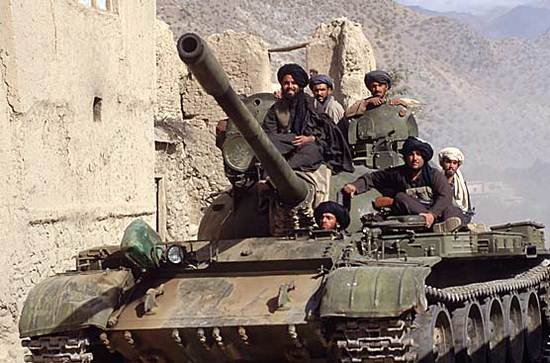
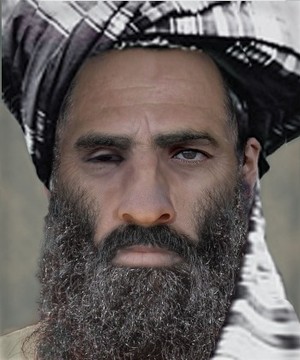
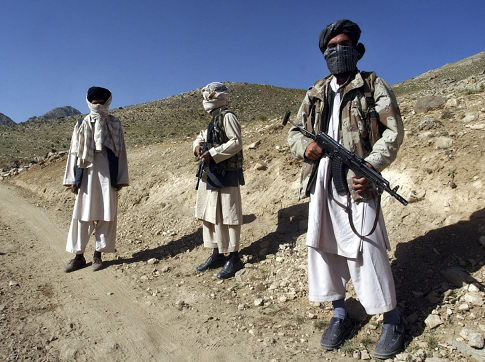
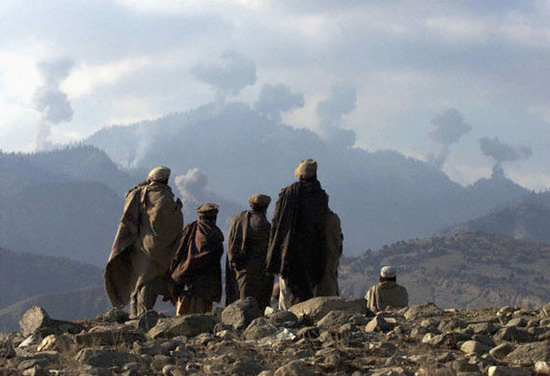
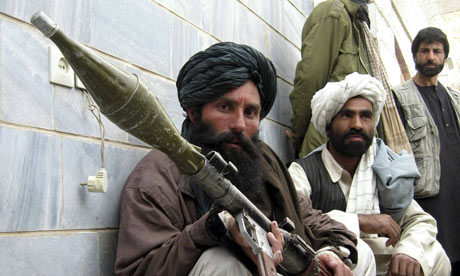
The Taliban, often spelled Taleban, is a militant Sunni-Islamist terrorist group that is dedicated to the implementation of a strict Deobandi form of Sharia (Islamic law) in Afghanistan. The Taliban is one of the most notorious terrorist organizations worldwide. Espousing a Sunni fundamentalist ideology, the Pashtun movement ruled most of Afghanistan from 1995 until 2001, when they were forced out of positions of power by an American offensive following the 9/11 attacks in the U.S. This volatile war has continued between the Taliban and International Security Assistance Forces (ISAF) coalition troops throughout 2011-2012 and continues to present a security problem. Throughout their existence the Taliban has continued to evolve, increasing their ability to function as a violent extremist organization.
The Taliban was formed in reaction to a power vacuum in Afghanistan following the defeat of the Russians in the Afghan-Soviet War, which ended in 1989. Various warlords had piecemealed portions of the country, and the Taliban aimed to liberate the Afghans from this control. Islamic religious scholars called mullahs, trained in Pakistan, operate beneath Taliban leader, Mullah Mohammed Omar. The rest of the movement was comprised of Pashtun tribesmen who trained in religious seminaries called madrassas from southern Afghanistan and northwestern Pakistan. Pashtuns are the second largest ethnic group in Pakistan, so there continues to be a strong tie between the terrorist group and their cultural brethren. This has become apparent through the support given by Pashtuns living in the Western tribal areas of Pakistan to Taliban and members of al Qaeda throughout the ongoing conflict with ISAF forces.
The Pakistani government supported the Taliban government for one particular reason; the Pakistanis believed they could control or influence the smaller government and therefore promote their own interests within Afghanistan, and possibly demonstrate a united front against India. Taliban fighters received invaluable training and arms from Pakistan’s Inter-Services Intelligence (ISI) and were able to take over rule of Kabul by 1996 and set up the Islamic Emirate of Afghanistan. After three years of capturing key areas in the country, the Taliban instituted a strict version of Islamic law, called Sharia, and their ranks swelled tremendously; the key areas included Kandahar, Herat, and Kabul. By 2000, the group controlled 90 percent of the country, even though only three other nations validated their legitimacy; Saudi Arabia, Pakistan, and the United Arab Emirates.[1]
Since their inception, the Taliban is known to have provided safe haven to many known terrorist individuals and groups. Their most notorious guest was Usama bin Laden (UBL) and his al Qaeda organization following the end of the Afghan-Soviet war. According to Pashtunwali, a Pashtun code of honor or culture, all guests are treated with the utmost hospitality; they are given shelter, food, and protection as if they were a part of that community. Al Qaeda was given refuge under this administration, and Mullah Omar refused to turn Usama bin Laden in to security forces. The UN Security Council imposed sanctions against the Taliban in 1999 for its support of Usama bin Laden’s network. The Taliban’s protection of UBL led to the U.S. invasion of Afghanistan in 2001, where protracted warfare still occurs today. However, after a ten-year search for bin Laden in various locations in Afghanistan and Pakistan, he was no longer under the protection of the Taliban; and was killed during an operation conducted by U.S. Navy SEALs on May 2, 2011 local time, in Abottabad, Pakistan. [2]
The Taliban fell in November 2001 after massive aerial bombardment and targeted physical attacks, just over a month after the International Security Assistance Force (ISAF) troops invaded Afghanistan. Many group members retreated to Pakistan, especially into the tribal areas. Taliban refugees were able to reorganize and re-arm, establishing themselves as a viable enemy against western occupation of Afghanistan in 2006. Officials speculated whether the resurgence in activity was due to dissatisfaction with the Afghan government (or its western support network), or if it was because of extensive Taliban intimidation tactics. Increases in attacks between Taliban fighters and coalition and Afghan soldiers were apparent in 2008, and even more so in 2009. In 2009, an International Council on Security and Development group report stated that the Taliban presence in Afghanistan extended over 80 percent of the region.[3] According to the NCTC, the Taliban claim responsibility for the largest number of terrorist attacks, and the most fatalities, over 90 other groups in operation during 2009.[4]
U.S. and coalition efforts to eliminate the insurgent/terrorist threat are often hindered by Taliban elements such as the Haqqani Network, Hezb-e-Islami Gulbuddin, al Qaeda (AQ), and Lashkar-e-Tayyiba, who continue to use the tribal areas in Pakistan as a base from which to launch attacks within Afghanistan and beyond. Al Qaeda leadership in Pakistan also maintains support to militants conducting attacks in Afghanistan. They, as well as other anti-coalition, foreign fighter organizations, continue to coordinate attacks with the Taliban and provide funding, training, and personnel to facilitate violent, sub-state operations. Not only does the group present a critical threat to the Afghan government, but they continue to threaten international security and stabilization efforts, particularly in south Asia.
The Taliban continues to target security forces Afghanistan. In 2011, the Taliban shifted tactics, using explosives in place of direct fire. This change in tactics has caused an increase in the number of civilian casualties.[5] According to a United Nations report, in 2010 the Taliban was responsible for 75 percent of civilian casualties in Afghanistan; in 2011 that number increased to 80 percent. [5][6] According to the London-based International Council on Security and Development (ICOS) report in 2011, the Taliban is utilizing explosive tactics in an effort to intimidate civilians and eliminate civilian confidence in Afghan security forces. This report also showed that in September 2011 a poll was conducted showing only 33 percent of the Afghan population had confidence in the abilities of Afghan security forces; this number has from 50% in June 2010. [1]